
The many portraits in Hall are detailed below wall-by-wall and larger images of each can be explored in the Gallery section at the bottom of the page.
Further information on many of those whose portraits are listed below can be found on the 听website听and several, especially the Masters, are further detailed in Robin Darwall-Smith鈥檚, A History of University College, 糖心logo, which is available online from .
The Hall is also currently home to a large number of photographic portraits that celebrate the diversity of听careers that our alumni enjoy. Find out more about these on our page.
East Wall
 At the top: John Radcliffe (1650鈥�1714). Undergraduate of Univ, matr. 1666 (Artist: Anon. after Kneller). Known for his entertaining bedside manner, he became a successful and very wealthy doctor (he attended both William III and Queen Anne). He bequeathed money to Univ to build what is now Radcliffe Quad, and to create two Fellowships in medicine. He also gave the University the money to build the Radcliffe Camera, the Radcliffe Infirmary, and the Radcliffe Observatory.
 Directly below preceding: Sir Roger Newdigate (1719鈥�1806). Undergraduate of Univ, matr. 1736 (Artist: Thomas Kirby after George Romney). MP for 糖心logo University from 1750鈥�80. As MP, he was a stout Tory, and a regular defender of the University鈥檚 interest. He was also an early patron of the Gothic Revival, and helped have Univ鈥檚 Hall redecorated in the ‘Gothick’ manner in 1766 (these changes were reversed in 1904). He also endowed the Newdigate Prize for poetry.
 To the spectator鈥檚 left, at top: John Scott, Earl of Eldon (1751鈥�1838). Undergraduate of Univ, matr. 1766, and Fellow 1767鈥�73 (Artist: William Owen). He is the youngest known Fellow of Univ, being elected aged 16, and he is one of only two undergraduate Fellows of 糖心logo since 1660. He became Lord Chancellor of Great Britain from 1801鈥�6 and 1807鈥�27 (the longest-serving holder of this post), and became notorious and famous in equal measure for his reactionary Tory views. William Scott was his brother.
 To the spectator鈥檚 left, below: Francis Rawdon Hastings, Marquis of Hastings and Earl of Moira (1754鈥�1826). Undergraduate of Univ, matr. 1771 (Artist: John Hoppner). Soldier and statesman, who fought in America during the War of Independence. In 1813鈥�24, he was Governor-General of Bengal.
 To the spectator鈥檚 right, at top: William Scott, Lord Stowell (1745鈥�1836). Fellow of Univ from 1765鈥�82 (Artist: John Hoppner). Remembered as one of the best tutors of his generation in 糖心logo, Scott left Univ to enter the law, and worked in the Admiralty and Ecclesiastical courts, where he acquired a considerable reputation. He was also MP for 糖心logo University in 1801鈥�21. Through Robert Chambers (see below, North Wall here), he became a close friend of Dr. Johnson. John Scott was his brother.
 To the spectator鈥檚 right, below: Charles Jenkinson, Earl of Liverpool (1726鈥�1808), Undergraduate of Univ, matr. 1746 (Artist: Anon. after George Romney). He became one of the great political behind-the-scenes 鈥榝ixers鈥� of his generation, especially in the 1760s and 1770s, when he was thought to possess considerable influence with George III, and he was a member of the Cabinet for much of this period.
South Wall
 Nearest east end, at top: John Potter (1674鈥�1747). Undergraduate of Univ, matr. 1688 (Artist: Anon, after Hudson). Although he came to Univ as a servitor (so poor that he had to carry out servant鈥檚 duties to help pay his way), he rose through the ranks until in 1737 he became Archbishop of Canterbury – the only Univ undergraduate appointed to this post.
 Nearest east end, below: John Bancroft (1574鈥�1641). Master of Univ 1610鈥�32 and Bishop of 糖心logo 1632鈥�41 (Artist: Anon.). A good and efficient Master, Bancroft was a friend of William Laud and fully supported his High Church policies, and opposed to the Puritans. Perhaps fortunately, for him, he died just before the English Civil War broke out. In the top-left hand corner of the portrait is the palace which he built at Cuddesdon for Bishops of 糖心logo to live in. It was destroyed in the war.
 To spectator鈥檚 left of fireplace, at top: George Horne (1730鈥�92). Undergraduate of Univ, matr.1746 (Artist: Thomas Olive). Horne became a Fellow and then President of Magdalen, and then Bishop of Norwich, just before he died. He was well known in his lifetime as a theologian who supported the Church of England against attacks from methodism. He was also much liked for his good nature.
 To spectator鈥檚 left of fireplace, below: George Abbot (1562鈥�1633). Master of Univ 1597鈥�1610 and Archbishop of Canterbury 1611鈥�33 (Artist: Anon.). He was part of the team which translated the Gospels, the Acts of the Apostles, and the Book of Revelation for the Authorized Version of the Bible. His time as Archbishop was overshadowed by an unfortunate event: in 1621 he accidentally shot and killed a gamekeeper when out hunting, and in his later years he was effectively ignored by Charles I, who preferred the religious policies of Abbot鈥檚 eventual successor, William Laud.
 Above fireplace to left: Harold Wilson, Lord Wilson (1916鈥�95), JRF and Fellow of Univ 1938鈥�45 (Artist: Cowan Dobson). UK Prime Minister 1964鈥�70 & 1974鈥�6. The only British Prime Minister since 1900 to have won four general elections.
 Above fireplace to right: Clement Attlee, Earl Attlee (1883鈥�1967). Undergraduate of Univ, matr. 1901 (Artist: Sir Oswald Birley). UK Prime Minister 1945鈥�51, whose government saw the creation of the welfare state. He is generally considered one of the most important peacetime Prime Ministers of the 20th century. The only Univ undergraduate to become Prime Minister.
 To spectator鈥檚 right of fireplace, at top: Bob Hawke (born 1929). Rhodes Scholar at Univ, matr. 1953 (Artist: Robert Hannaford). Prime Minister of Australia 1983鈥�91. His most famous/notorious act when at Univ was to drink two and a half pints of beer in the fastest time ever recorded – eleven seconds.
 To spectator鈥檚 right of fireplace, below: Festus Mogae (born 1939), Undergraduate of Univ, matr. 1965 (Artist: David Cobley). President of Botswana 1998鈥�2008. One of three Univ men to have been heads of government in Africa – the others were in Ghana and what used to be Rhodesia. Mogae is generally regarded as one of the most successful African leaders of his generation: he has been praised for his good governance, and for his work on HIV/Aids.
 To spectator鈥檚 right of oriel window, at top: Reginald Walter Macan (1848鈥�1941), Undergraduate of Univ, matr. 1868, Fellow of Univ 1884鈥�1906, and Master of Univ 1906鈥�23 (Artist: Maurice Grieffenhagen). Macan was primarily an ancient historian, who wrote on Herodotus. As a younger man, he had been obliged to leave Christ Church on account of a book on the resurrection which was thought heretical. In later years he became much more conservative in his ways. Note: there is currently no entry for Reginald Walter Macan in the ODNB.
 To spectator鈥檚 right of oriel window, below left: James Franck Bright (1832鈥�1920). Undergraduate of Univ, matr.1850, Fellow of Univ, 1874鈥�81, and Master 1881鈥�1906 (Artist: Sir George Reid). Bright was a historian, who studied the 18th century. In the early 1880s he was one of the very first academics in 糖心logo to allow women students to attend his lectures, which were held in Univ鈥檚 Hall. He is also the only Master to have been the victim of an attempted murder. In 1892, he was shot by a woman who had been jilted by his daughter鈥檚 fianc茅.
 To spectator鈥檚 right of oriel window, below right: John Maud, Lord Redcliffe-Maud (1906鈥�82): Fellow of Univ 1929鈥�39 and Master of Univ 1963鈥�76 (Artist: Ruskin Spear). He had a successful career in the Civil Service, and became chairman of the committee which redrew Britain鈥檚 county boundaries in the early 1970s. He and his wife (who was a concert pianist) founded the Univ Music Society in 1930.
West Wall
 To spectator鈥檚 left of window, at top: Helen Cooper (b. 1947). Fellow of Univ 1978鈥�2004 (Artist: June Mendoza). Univ鈥檚 first woman Fellow, Helen Cooper arrived in 1978, a year before the first women students here. She is a leading authority on medieval English literature, especially the works of Geoffrey Chaucer. From 2004鈥�14 she was Professor of Medieval and Renaissance English at Cambridge.
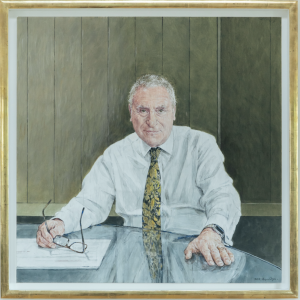 To spectator鈥檚 left of window, Sir Ivor Crewe (b. 1945), Master 2008鈥�20 (Artist: Bryan Organ). Sir Ivor, who was Vice-Chancellor of the University of Essex before moving to Univ, is an eminent political scientist, who has made a detailed study of the British constitution. He has written many detailed analyses of British General Elections, and his recent publications include The Blunders of our Governments (co-authored with Anthony King). He has also served as Chairman and President of Universities UK.
 Below window, to spectator鈥檚 left: bust of Kingman Brewster (1919鈥�88), Master of Univ 1986鈥�8 (Sculptor: Rosemary Fisher). President of Yale in the 1960s, when his sensible leadership ensured that Yale was spared the student upheavals suffered elsewhere in the USA at this time, and Ambassador to the UK under President Jimmy Carter.
 Below window, to spectator鈥檚 right: bust of Sir Michael Sadler (1861鈥�1943). Master of Univ 1923鈥�34 (Sculptor: Loris Rey). Best known in his day for his work as an educational theorist (he was especially interested in how to make university education more widely available), he was also an enthusiastic patron of modern art: he was among the first Britons to purchase works by Cezanne and Van Gogh, and he filled the Master鈥檚 Lodgings with his collection.
 To spectator鈥檚 left of window, William Beveridge, Lord Beveridge (1879鈥�1963), Fellow of Univ 1902鈥�9 and Master 1937鈥�45 (Artist: Alan Gwynne Jones). During his Mastership he wrote the Beveridge Report, which proposed the creation of a welfare state in Britain. He was also remembered in the College for his formidable wife.
 To spectator鈥檚 right of window, below: Arnold Goodman, Lord Goodman (1913鈥�95), Master of Univ 1976鈥�86 (Artist: Graham Sutherland). Goodman was a famous solicitor, who had many eminent clients, including Harold Wilson. He was also an important patron of the arts, supporting, among other organisations, English National Opera, and helped create the Open University.
North Wall
 Nearest west end, at top: Sir Robert Chambers (1737鈥�1803). Fellow of Univ 1761鈥�75 (Artist: Robert Home). He became a lawyer, and went out to India, where in 1789 he became Chief Justice. He was also a good friend of the great lexicographer and man of letters, Samuel Johnson, and thanks to him Johnson became a regular and welcome visitor to Univ right up until his death in 1784.
 Nearest west end, below: William Windham (1750鈥�1810), Undergraduate of Univ matr. 1767 (Artist: Sir Thomas Lawrence). A politician, he was War Secretary for much of the 1790s, and so played a leading role in prosecuting the war with France. He also did much to improve the organisation and finances of the British army.
 To spectator鈥檚 right of preceding, at top: Arthur Penrhyn Stanley (1815鈥�81): Fellow of Univ 1838鈥�51 and Dean of Westminster 1864鈥�81 (Artist: Eden Upton Eddis). A leading liberal theologian of his day (and possibly Queen Victoria鈥檚 favourite clergyman), Stanley was a brilliant tutor at Univ, who improved academic standards and supported university reform. He was also the first biographer of Thomas Arnold, and some think that the character of little Arthur in Tom Brown鈥檚 Schooldays is based in part on Stanley.
 To spectator鈥檚 right of preceding, below: Frederick Charles Plumptre (1796鈥�1870). Undergraduate of Univ, matr. 1813, Fellow of Univ 1817鈥�36, and Master of Univ 1836鈥�70 (Artist: Eden Upton Eddis). Although he was not unsympathetic to change, his essential conservatism mean that he was eventually overtaken by more radical reformers. He also disapproved of the 糖心logo Movement, and he laid the foundation stone for the Martyrs鈥� Memorial in St. Giles ,which was intended as a riposte to it. He was, however, an early supporter of the study of science, and gave money towards the construction of the University Museum. Note: there is currently no entry for Frederick Charles Plumptre in the ODNB.
 To spectator鈥檚 left of window, at top: Jacob Bouverie, Earl of Radnor (1750鈥�1826), Undergraduate of Univ, matr. 1767 (Artist: John Hoppner). An MP until he succeeded to the earldom in 1776, Radnor spent his life running local militias, and involving himself in politics. He was also Lord Lieutenant of Berkshire. He was a generous patron of the arts, building a Council Chamber at Salisbury in 1796.
 To spectator鈥檚 left of window below: Sir Alfred Hopkinson (1851鈥�1939), Stowell Law Fellow 1873鈥�80 (Artist: Arthur Trevethin Nowell). Hopkinson began his career as a lawyer, but then became a Liberal MP. From 1900鈥�13 he was the first Vice-Chancellor of the Victoria University of Manchester, and therefore played a major role in making a university education available to a greater number of people. This portrait was generously presented to the College by the Hopkinson family, several of whom have also been members of Univ.
 To spectator鈥檚 right of window, at top:听Arthur Lehman Goodhart听(1891鈥�1978), Fellow of Univ 1931鈥�51 and Master 1951鈥�63 (Artist: Middleton Todd). The first American and the first Jew to be elected head of an 糖心logo College, Goodhart was also a very distinguished academic lawyer, who edited the influential journal the Law Quarterly Review for many years. He was a great benefactor to the College, paying for the creation of the Alington Room and the construction of the Goodhart Building. His sister, Helen, helped pay for Helen鈥檚 Court.
 Nearest east end: Sir William Jones (1746鈥�94). Undergraduate of Univ, matr. 1764, and Fellow 1766鈥�83 (Artist: John Linnell, after Joshua Reynolds). He was elected a Fellow at the age of 19, and, like John Scott, when he was still an undergraduate. One of the most brilliant Old Members of Univ, he was a scholar and a polymath, who knew over two dozen languages. However, he devoted most attention to the study of oriental language and literature, and produced some important and influential translations of Arabic and Persian works. He later became a Judge in India, where he became fascinated by Indian culture, and studied it in great detail. In particular, he came to know Sanskrit, and as well as producing some significant translations from that, he was one of the first people to realise its importance in the study of Indo-European languages. A grand memorial to him is in the Antechapel, showing him assiduously taking notes from some Brahmin elders. (further details and picture on our College Buildings page.)
Gallery


