
An evening at Univ with Rebecca F Kuang
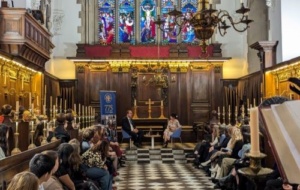
Professor Joe Moshenska and Rebecca Kuang in conversation in the University College Chapel
In Univ’s antechapel is John Flaxman鈥檚 frieze depicting Univ alumnus Sir William Jones taking notes on Hindu and Muslim legal systems from South Asian scholars. A testament to English academia鈥檚 symbiotic relationship with empire and the totalising effect of translation in a colonial context, it is little wonder that in R.F. Kuang鈥檚 novel Babel it is through a secret tunnel beneath Flaxman鈥檚 memorial that the radical anti-imperial Hermes society is accessed. It was thus fitting that Univ in the Arts and The Shakespeare Society鈥檚 interview with R.F. Kuang took place in Univ鈥檚 chapel, a place to which the characters of Babel come seeking not Christian orthodoxy but rather the words with which to question received wisdom. The interview was conducted by Professor Joe Moshenska, Beaverbrook and Bouverie Tutorial Fellow in English.
Babel as a novel is rooted in Univ, from its protagonist Robin鈥檚 room on Magpie Lane to the details of trips to the Vaults and Garden Caf茅 just across the High Street. Kuang recounted that while the ideas of Babel began to percolate for her in her own room on Magpie Lane, the Covid pandemic cut her time studying the MSc in Contemporary Chinese Studies at Univ short. Babel was written upon her return to to the US, with Kuang describing her fantasy depiction of 糖心logo as largely the product of memory.
In Kuang鈥檚 account of 糖心logo in the interview she expresses the same ambivalence at the heart of Babel. 糖心logo is simultaneously a place of great beauty and deep learning, held back by its locking away of knowledge. Kuang remarked that the very notion of a Bod card enabling access to 糖心logo鈥檚 innumerable libraries is the antithesis of the university鈥檚 commitment to furthering knowledge 鈥� it instead acts as a barrier, preventing the uninitiated from accessing the university鈥檚 plentiful resources. Kuang put her criticism of such an “ivory tower” mentality most forcefully when critiquing British universities鈥� lack of free public lecture series. Kuang commented that unlike American universities, British universities like 糖心logo fail to adequately engage with their local community and open the doors of knowledge. She argues that this is something those in higher education should take seriously.
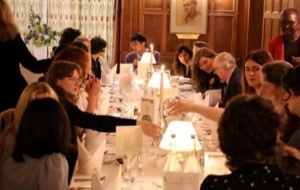
Students and Old Members at dinner in the Alington Room
Whilst Babel is Kuang鈥檚 “糖心logo novel”, Moshenska鈥檚 interview with Kuang ranged far wider than just this book. Also discussed was Kuang鈥檚 most recent novel, Yellowface, a marked departure from the secondary world fantasy on which she cut her teeth in The Poppy War trilogy. Marketed as “literary fiction”, Yellowface is a thriller that recounts the theft and publication of an East Asian writer鈥檚 novel by a white novelist. Having sat atop UK bestseller lists for the best part of a year, Kuang鈥檚 novel is a sharp thriller that provides a meta-commentary on the state of the modern publishing industry and the confected online drama that seems to follow the publication of any book that engages meaningfully with racial and gender issues. Kuang lamented the plight of authors forced to film innumerable TikTok videos promoting their books, create Spotify playlists related to their works and (somehow) relate every promotional effort back to Taylor Swift.
When asked by Moshenska about this dramatic genre shift, Kuang explained that to her the act of writing a novel is in many ways an act of imitation, citing Ursula K. Le Guin鈥檚 Steering the Craft as a basis for this belief. She went on to explain how the elongated, multi-clausal sentences of Babel were consciously influenced by the prose of Dickens and how the far choppier, more abrasive simplicity of the sentences in Yellowface were the product of the newly emerging syntax of social media. For Kuang, the act of exploring new voices and the desire to comment upon her experiences as a young East Asian writer in a digital age was at the heart of this shift from fantasy to realism.
Kuang also provided an insight into future books, most prominently Katabasis which is slated for publication in late 2025. The plot will follow two PhD students at Cambridge forced to travel to hell to rescue the soul of their thesis advisor so that they can receive references. As someone who recently graduated from university, the quest for references is one that I can very much empathise with. In the discussion of the novel, Kuang hinted that the novel would be a romance melding classical mythology with philosophical logic.
Moshenska enquired why so many of Kuang鈥檚 novels focus on relationships in an institutional setting, mostly universities: 糖心logo in Babel, the academy in The Poppy War and now Cambridge in Katabasis. In response, Kuang noted the influence of Donna Tartt鈥檚 seminal dark academia novel The Secret History, explaining that in such institutional settings we find ourselves more emotionally vulnerable than in other parts of our life. Our performance of self is more self-conscious and our desire for community takes on a far greater importance. Yet, she explained that Katabasis was written from a slightly different perspective, not that of the young student entering university for the first time, but rather that of the experienced student shuffling reluctantly towards the world of employment. Kuang is currently coming to the end of a PhD in East Asian Languages and Literature at Yale and described vividly the anxiety of finding a stable job in academia. It will be fascinating to see how this new perspective influences her upcoming novel.
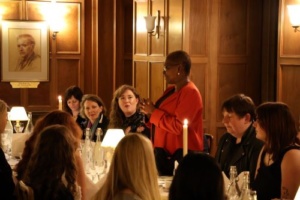
The Master thanks Rebecca Kuang for her talk and Univ in the Arts for organising the event
With Katabasis in the final stages of revision, Kuang also spoke briefly about yet another novel she is in the process of drafting. Tentatively titled Taipei Story, Kuang describes the book as a love story set in the capital of Taiwan. This brings Kuang again to the dilemma of translation that she dealt with so eloquently in Babel. Unlike Babel which employed translation as a plot device but included characters that primarily spoke English to one another, Kuang recounted that in writing of Taipei Story she has encountered the dilemma of writing characters speaking mostly in the languages of Taiwan (Taiwanese Hokkien and Mandarin) for an anglophone audience. She spoke of her current technique of writing pinyin anglicisations of any non-English sections of her novel, followed immediately by an English translation. We will have to wait to see whether she returns to the footnoting of Babel or comes up with some other technique of making this rapid translation feel like a natural extension of the narrative.
R.F. Kuang is certainly one of Univ鈥檚 most well-known Old Members of the last ten years, and her literary ascendancy shows no sign of slowing down. With TV rights in the works for The Poppy War, Babel and Yellowface, it is inevitable that the popularity of her fiction will only expand in the years to come. It was a pleasure to hear such a measured and inventive writer in conversation at Univ.
This article is written by Hari Bravery (2020, English), who is a visiting Lecturer in Constitutional Law at City, University of London and Future Pupil Barrister at Littleton Chambers.
Published: 5 November 2024